



Key Takeaways:
- All Three Serve The Same Pathway: NAD+, NMN, and NR all feed into the same cellular system, but each one enters that system at a different point.
- NMN And NR Are Building Blocks: Both are precursors that the body converts into NAD+, while NAD+ itself is the finished coenzyme your cells actually use.
- The Research Looks Different For Each: NMN and NR both have human trials behind them, while direct oral NAD+ has been studied less, largely because of questions about how well it survives digestion.
If you've spent any time researching cellular aging, you've likely seen NAD+, NMN, and NR mentioned in the same breath, sometimes as if they were interchangeable. They're closely related, but they aren't the same compound, and they don't follow the same route through your body.
Knowing how they differ can make supplement labels a lot less confusing and help you ask better questions about what you're taking. At Sunny Within, the NAD+ vs. NMN vs. NR comparison shaped how we built our NAD+ formula, including which molecules to include, which to combine, and what delivery system to use.
This article explains how each molecule fits into the bigger picture, what human research has measured so far, and how to think about choosing between them.
The NAD Pathway: How Three Molecules Connect
The NAD pathway is the series of steps your body uses to build, use, and recycle NAD+ (nicotinamide adenine dinucleotide). It helps to picture it like a highway with several on-ramps. Some molecules merge on early and travel a few exits before reaching the destination, while others join much closer to the end. NMN (nicotinamide mononucleotide) and NR (nicotinamide riboside) are two of those on-ramps, and NAD+ is the destination itself.
Once NAD+ arrives, it has plenty of work to do. It acts as an electron carrier in the reactions that produce cellular energy, and it's required by two enzyme families that researchers watch closely: sirtuins, which help regulate stress responses and gene expression, and Poly(ADP-ribose) polymerases (PARPs), which help repair breaks in DNA.* Research on human tissue samples has found that NAD+ levels tend to decline with age, alongside changes in markers of oxidative stress (Massudi et al., 2012). That observation is a big reason scientists began exploring whether NAD+ or its precursors could help support those levels over time.

The NAD+ NMN NR Difference, Molecule By Molecule
The difference between the three really comes down to where each molecule joins the pathway and how many conversion steps stand between it and the finished coenzyme.
NAD+: The Finished Product
NAD+ is the active form your cells use directly, so there's no conversion required once it's inside a cell. The challenge is getting it there. NAD+ is a relatively large molecule, and in standard oral form, it faces open questions about how much survives digestion and crosses into circulation intact. That's why delivery format tends to come up so often in conversations about direct NAD+ supplementation. So, what is a NAD+ supplement? Put simply, it's any product designed to support your body's NAD+ levels, whether by delivering NAD+ directly, supplying a precursor like NMN or NR, or combining both approaches.
NMN: One Step Away
NMN sits just one enzymatic step from NAD+. Enzymes called NMNATs (nicotinamide mononucleotide adenylyltransferases) convert it into NAD+ through a process your cells already carry out naturally. Its position so close to the end of the pathway is a big part of why NMN has become one of the most actively studied precursors in recent years.
NR: An Earlier On-Ramp
NR is a form of vitamin B3 that joins the pathway a little further back. Your body first converts NR into NMN and then converts that NMN into NAD+, which means NR takes two steps to reach the destination instead of one. That extra step doesn't make NR ineffective, since it has a well-established research history of its own, but it does change the route.
NMN vs NR vs NAD: What Human Studies Have Measured
When you look at the research side by side, the depth of evidence differs quite a bit from one molecule to the next.
To start, NR was among the first precursors studied in people. In one trial of older men, NR supplementation raised levels of NAD+-related metabolites in skeletal muscle and was well tolerated over the study period (Elhassan et al., 2019). NMN research picked up momentum a little later, and human trials have grown steadily since. In a randomized, double-blind, placebo-controlled study, a clinically-studied dose of NMN significantly increased blood NAD+ levels in healthy adults aged 40 to 65 at both 30 and 60 days.†
Direct oral NAD+ has received comparatively less clinical attention, mostly because of the absorption questions mentioned above. That gap is exactly why Sunny Within's NAD+ protects direct NAD+ in a waterless liposomal system and pairs it with NMN, so no single molecule has to make the trip alone.* Across all three molecules, individual responses vary, and researchers are still working to understand what changes in NAD+ levels mean for long-term health outcomes.

Which Is Better: NMN, NR, Or NAD?
It's normal to want a clear winner, but asking which is better doesn't have a single universal answer. A few factors can help you think it through more clearly:
- Conversion Steps: NAD+ requires no conversion, NMN requires one step, and NR requires two, which affects how directly each one feeds into the pathway.
- Research Depth: NR and NMN both have human trials behind them, while direct oral NAD+ has a thinner clinical record so far.
- Delivery Format: How a molecule is packaged can influence how much of it reaches circulation, so the format can matter almost as much as the molecule itself.*
- Your Goals: Some people want to support their body's own NAD+ production over time, while others are interested in delivering the finished molecule directly, and those goals can point in different directions.
Thinking about these factors together usually leads to a more useful question than "which one wins." It tends to shift the focus toward how a formula addresses the pathway as a whole.
Is There A Best NAD Precursor?
When people search for the best NAD precursor, NMN often comes up because of its proximity to NAD+ and its growing body of human research. Still, choosing a precursor in isolation isn't the only approach. Some formulas combine a precursor with NAD+ itself, so the pathway gets support from more than one point at once, with the finished molecule available directly while the precursor supports the body's own production.*
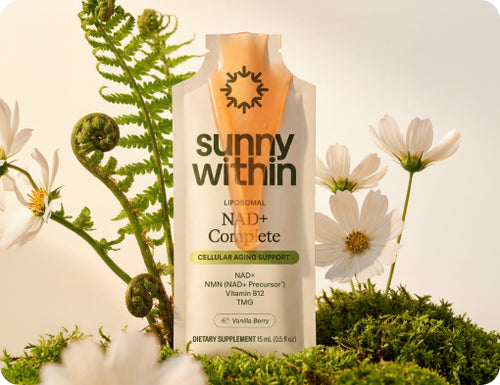
Other details can matter, too. Converting NMN into NAD+ draws on the body's methyl groups, which is why some formulas include supporting nutrients like trimethylglycine (TMG) and vitamin B12 to help keep that cycle running efficiently.* Sunny Within's NAD+ is built exactly this way: 50mg of direct NAD+ and 400mg of NMN, with 500mg of TMG and 300mcg of B12 for methylation support, in a waterless liposomal system made with organic coconut-derived MCT oil and avocado oil.* Whatever direction you lean, comparing how a product approaches the full pathway is often more informative than comparing single ingredient names.

Final Thoughts
NAD+, NMN, and NR aren't rivals so much as different entry points into the same system. NAD+ is the finished coenzyme, NMN sits one step away, and NR joins a little earlier. The most complete approach doesn't pick just one. It supports the pathway from more than one point, which is why Sunny Within's NAD+ pairs protected, direct NAD+ with a clinically-studied dose of NMN and the methylation nutrients that keep conversion running.† As always, check with your healthcare provider before adding anything new to your routine.
Frequently Asked Questions About NAD+ vs. NMN vs. NR
What is the main difference between NAD+, NMN, and NR?
NAD+ is the active coenzyme your cells use directly, while NMN and NR are precursors your body converts into NAD+. NMN is one step away from NAD+, and NR converts into NMN first before becoming NAD+.
Is NR the same as vitamin B3?
NR is a form of vitamin B3, alongside other forms like niacin and nicotinamide. Each form enters NAD+ production in a slightly different way, which is why they aren't considered identical.
Which has more human research, NMN or NR?
NR was studied in people earlier, so it has a longer research history. NMN human trials have grown quickly in recent years, and both now have studies showing effects on NAD+-related measures.
Why isn't direct oral NAD+ studied as much?
NAD+ is a relatively large molecule, and researchers have questions about how much of it survives digestion in standard oral form. Delivery systems like liposomes are designed to help address that challenge.*
Can NAD+ and NMN be taken together?
Yes. Sunny Within's NAD+ combines them in one pouch, so direct NAD+ supports your levels right away while NMN supports your body's own production over time.* It's always a good idea to review any new combination with your healthcare provider, especially if you take other supplements or medications.
How long does it take for NAD+ precursors to affect NAD+ levels?
Human studies on NMN and NR have typically run for several weeks, with changes in NAD+-related measures observed within those study periods. Individual responses vary, and consistent daily use tends to matter most.
|
*This statement has not been evaluated by the Food and Drug Administration. This product is not intended to diagnose, treat, cure, or prevent any disease. † These statements have not been evaluated by the Food and Drug Administration. This product is not intended to diagnose, treat, cure, or prevent any disease. Clinical reference: Yi L, et al. GeroScience. 2022. Study conducted on NMN as a standalone ingredient. |
Sources:
- Massudi, H., Grant, R., Braidy, N., Guest, J., Farnsworth, B., & Guillemin, G. J. (2012). Age-associated changes in oxidative stress and NAD+ metabolism in human tissue. PLoS ONE, 7(7), e42357.
- Elhassan, Y. S., Kluckova, K., Fletcher, R. S., Schmidt, M. S., Garten, A., Doig, C. L., Cartwright, D. M., Oakey, L., Burley, C. V., Jenkinson, N., Wilson, M., Lucas, S. J. E., Akerman, I., Seabright, A., Lai, Y. C., Tennant, D. A., Nightingale, P., Wallis, G. A., Manolopoulos, K. N., Brenner, C., Philp, A., & Lavery, G. G. (2019). Nicotinamide riboside augments the aged human skeletal muscle NAD+ metabolome and induces transcriptomic and anti-inflammatory signatures. Cell Reports, 28(7), 1717–1728.
- Yi, L., et al. (2022). The efficacy and safety of β-nicotinamide mononucleotide (NMN) supplementation in healthy middle-aged adults: a randomized, multicenter, double-blind, placebo-controlled, parallel-group, dose-dependent clinical trial. GeroScience.

