
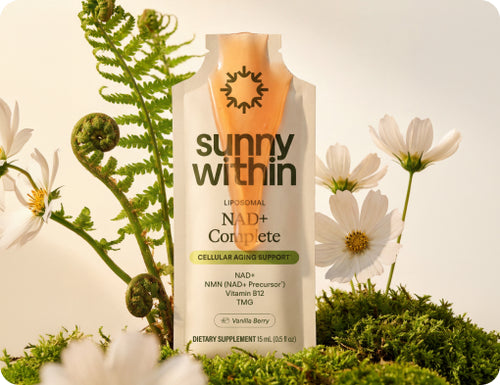

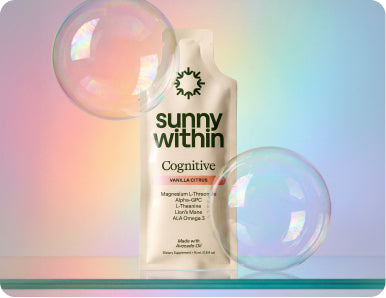

Introducing our most advanced NAD+ formula yet: NAD+ Complete
By Mikaela Zuck, Nutritionist, Brand Education at Sunny Within
What to Know
- NAD+ levels drop by up to 50% between your 20s and 50s, affecting energy, skin, cognition, and cellular repair
- Most NAD+ supplements only address one point on the pathway — not the full picture
- IVs deliver NAD+ directly to the bloodstream, but they're expensive, inconvenient, and not sustainable as a daily habit
- High-dose oral NAD+ (200mg+) has not been shown in research to successfully raise NAD+ levels in the body
- NMN is one of the most studied NAD+ precursors, shown in clinical trials to significantly increase blood NAD+ levels within 30 and 60 days*
- TMG and B12 are critical support ingredients that most NAD+ formulas skip entirely
There's a specific kind of frustration I hear all the time. Someone is doing everything right. They're sleeping pretty well, moving their body, eating in a way they feel good about…and something still feels off. Energy is dragging. Skin is looking noticeably older all of a sudden after 40. It's harder to stay focused and motivated all day.
And these people aren't imagining it. They're not being dramatic. What they're experiencing is real, it's measurable, and there's a molecule sitting right at the center of most of it.
That molecule is NAD+. And once you understand what it does and what happens when it starts to decline, a lot of things start to make a lot more sense.
What's Actually Happening in Your Body After 40
The afternoon energy crash that coffee doesn't really fix anymore…that's cellular energy. Your mitochondria, the power plants of your cells, run on NAD+. When NAD+ declines, mitochondrial output drops with it. The tiredness feels different than it used to because it is different.
The skin stuff is real too. I know skincare gets a lot of the credit (or blame) for how skin ages, but there's a cellular layer underneath all of that. NAD+ plays a significant role in skin cell turnover and repair. As levels decline, the skin's ability to renew itself slows down. Elasticity, luminosity, the way fine lines accumulate. A lot of that is happening at a cellular level that your retinol genuinely cannot reach.
Focus and cognitive sharpness. NAD+ fuels brain energy metabolism. The brain uses roughly 20% of the body's total energy despite being only about 2% of its mass. When the fuel supply at the cellular level is compromised, you feel it upstairs.
Recovery that takes longer than it used to. Cellular repair processes, including DNA repair, are NAD+-dependent. Slower recovery after exercise, illness, a bad night of sleep. All connected.
By your fifties, most people have roughly half the NAD+ they had at twenty. That's not a small shift. That's the molecule behind your energy, your skin, your cognition, and your cellular repair running at half capacity.
None of this is inevitable. But understanding the mechanism is what makes it addressable.
How People Try to Fix It (And Why Most Approaches Fall Short)
Once someone figures out that NAD+ is part of what's going on, the next question is pretty natural: how do I get more of it? And there are a few different answers floating around out there. Here's my honest take on each of them.
NR (nicotinamide riboside). This was the first big wave of NAD+ supplementation. NR is a precursor your body converts to NMN, and then to NAD+. Two conversion steps. It's stable in capsule form, which is why it got so popular, but it's the most indirect route on the pathway. Depending on how efficiently your body handles that conversion — and that efficiency declines with age — a meaningful amount of what you're taking may not make it where you need it to go.
NMN (nicotinamide mononucleotide). One step closer to NAD+, and it has its own dedicated cellular transporter that moves it directly into cells. More direct than NR, and the clinical evidence behind it is genuinely strong. But on its own, it still only addresses one part of the equation. And there's a conversion step it relies on that draws on your body's methyl groups — a limited resource — which most formulas don't account for at all.
High-dose oral NAD+. This is where I want to spend a minute, because I see a lot of brands leaning into big label numbers. 200mg. 300mg. More. The idea is intuitive: if NAD+ is what you need, just take a lot of NAD+, right?
Here's the problem. NAD+ is a large, fragile molecule. In a standard oral format, it breaks down in the digestive environment before it ever reaches your cells. And the research actually reflects this — high-dose oral NAD+ (200mg and above) has not been shown to successfully raise NAD+ levels in the body. A bigger number on the label isn't a better product. It's often just a bigger number.
IV NAD+. IVs do work in a meaningful way — delivering NAD+ directly to the bloodstream bypasses the absorption problem entirely. If you've done IV NAD+ and felt something, that tracks. But at $500 to $1,000 a session, sitting in a clinic for hours at a time, it's not a realistic daily habit for most people. Plus, it often comes with nausea or stomach cramping. It's an acute intervention, not a sustainable foundation.
So that's the landscape. Each approach addresses something real, but none of them solve the whole picture.
A Complete Approach: Formula and Delivery, Designed for Your Entire NAD+ Pathway
NAD+ Complete is built differently.
Instead of picking one entry point on the pathway and calling it a day, it's designed to work on all three parts at once.
Direct NAD+ via waterless liposomal delivery. Our waterless liposomal system encapsulates NAD+ in a protective lipid layer, made with good fats like MCT, avocado oil, and almond butter, that shields it through digestion and delivers it where it actually needs to go. The waterless formulation specifically enhances NAD+ stability in a way that water-based liposomal systems don't. So 50mg of properly protected, delivered NAD+ is doing something that 300mg in a capsule just can't.
400mg NMN for sustained production. Direct NAD+ and NMN work through completely separate mechanisms. The liposomal NAD+ delivers the finished molecule right now. The NMN enters cells via its dedicated transporter and supports your body's own ongoing NAD+ production over time.*
TMG and B12 for methylation support — the step almost every formula skips. When NMN converts to NAD+, it draws on your body's methyl groups. These are molecular units used in hundreds of biochemical processes, and they're a limited resource. Without replenishment, the conversion cycle bottlenecks. You're essentially running NMN into a wall.*
TMG (trimethylglycine) at 500mg donates methyl groups to keep that cycle running efficiently. Vitamin B12 as methylcobalamin (the most bioavailable form) is a direct cofactor in the same process. Most NAD+ formulas don't include both of these. They're arguably among the most important ingredients in a targeted NAD+ formula, but because most formulas are built around the headline ingredient rather than around how the whole system actually works.*
What the Research Shows about NMN and NAD+ levels
NMN has one of the strongest human clinical evidence bases of any NAD+ precursor available right now.
The anchor study I keep coming back to: a 2022 randomized, double-blind, placebo-controlled trial. 80 healthy adults between 40 and 65, over 60 days. All NMN groups showed significant increases in blood NAD+ levels compared to placebo at both day 30 and day 60. Our 400mg dose in NAD+ Complete falls within the effective range studied.†
What to Expect
Real talk on timeline, because this is where people get either unrealistic expectations or give up before things have had time to work.
Some people notice shifts in energy and mental clarity within the first week or two. That does happen, and it's real, but it's not universal and it's not the whole story.
NAD+ levels build over weeks of consistent use. The clinical study on NMN showed significant increases at 30 days, with continued improvement at 60 days. The deeper benefits — skin quality, cellular resilience, DNA repair support — those develop over 8 to 12 weeks of consistent daily use.
This is cellular nutrition. The people who get the most out of it are the ones who commit to a couple of months and pay attention to the cumulative shifts rather than waiting for a dramatic day-one moment.
NAD+ Complete absorbs well with or without food. Because it's liposomal and made with good fats, it doesn't need a meal to support absorption, though a lot of people find it fits naturally into a morning routine.
How It Fits Into the Bigger Picture
NAD+ Complete is designed for someone who specifically wants to go deep on their NAD pathway. The full system, not just one piece of it.
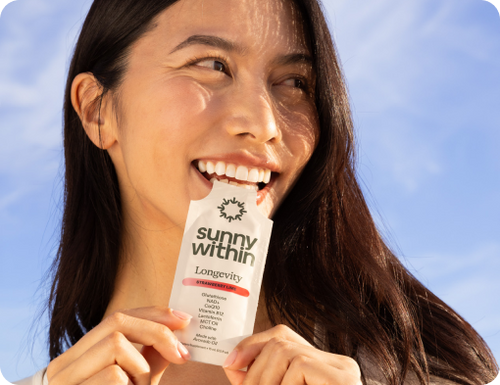
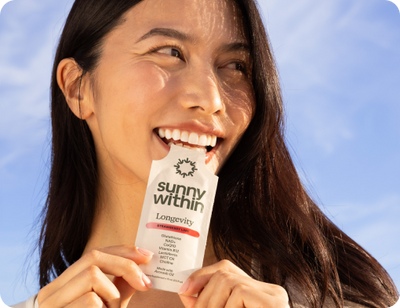
If you're already taking Longevity, NAD+ Complete adds a dedicated NAD+ layer to a total-body foundation that already includes glutathione, CoQ10, and lactoferrin. They're designed to work together, not compete.
If NAD+ optimization is your primary focus and you're starting fresh, NAD+ Complete is built precisely for that.
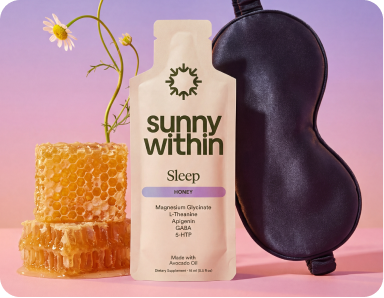
It also pairs naturally with Cognitive for brain support and Sleep — cellular repair is most active during sleep, and supporting the NAD pathway overnight is one of the more underrated things you can do for recovery.
The Bottom Line
The shifts you're feeling after 40 aren't just general aging. They're tied to NAD+ decline.
Most NAD+ supplements pick one entry point on the pathway and stop there. An IV gets expensive fast and isn't something you can sustain. High-dose oral NAD+ sounds logical but the research doesn't back it up.
NAD+ Complete is built to actually solve that. Protected delivery, sustained production, and the methylation support that keeps the whole conversion cycle running. The whole pathway, not just the headline ingredient.
That's what this formula was built to be.

Mikaela Zuck is a nutritionist and Brand Education lead at Sunny Within. She holds clinical dietitian training from Australia and brings a science-first, people-first approach to supplement education.
†Clinical reference: Yi L, et al. GeroScience. 2022. Study conducted on NMN as a standalone ingredient. These statements have not been evaluated by the Food and Drug Administration. This product is not intended to diagnose, treat, cure, or prevent any disease.
*These statements have not been evaluated by the Food and Drug Administration. This product is not intended to diagnose, treat, cure, or prevent any disease.


