

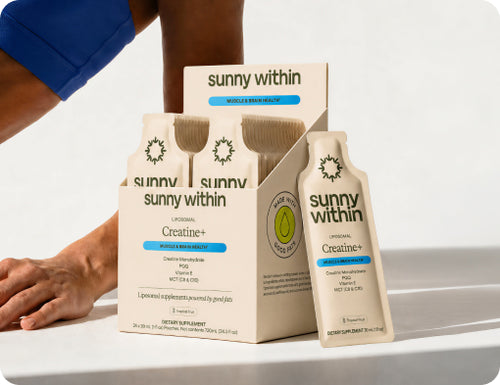




Meet Sunny Within's longevity-focused Creatine+ supplement.
By Mikaela Zuck, Nutritionist, Brand Education @ Sunny Within
What to Know
- Creatine is one of the most studied nutrients in human history, but most people only know it from gym culture
- Women naturally store about 70–80% less intramuscular and brain creatine than men, and that gap widens with age and hormonal shifts
- Creatine is also crucial for brain function, bone density, preserving muscle with age, and even mood
- Sunny Within's Creatine+ pairs 5g liposomal creatine monohydrate with PQQ for a longevity-focused formula (with no loading protocol, mixing, or bloating)*
The mountain of research on creatine monohydrate
Creatine is one of the most studied nutrients in human history. Decades of research, thousands of clinical participants, a safety profile that basically nothing else in the supplement world can match. And yet most people think of it as something you mix into a shaker bottle before a workout, if they think about it at all.
That's not wrong, exactly. Creatine absolutely supports athletic performance. But it's maybe 20% of the story.
So let's look at what creatine is actually doing in the body. Because once you understand the mechanism, the gym application starts to feel like the footnote rather than the headline.
What Creatine Actually Does (That Has Nothing to Do With Weightlifting)
Creatine's job in the body is to replenish ATP, adenosine triphosphate, the molecule your cells use as energy currency. Every time a cell does something — contracts a muscle, fires a neuron, repairs damaged DNA, pumps ions across a membrane — it burns ATP. And creatine is how your body rapidly regenerates that supply.
That's not a gym thing. That's a life thing.
Your brain runs on ATP
Your brain uses roughly 20% of your body's total energy despite being about 2% of your body weight. It is extraordinarily demanding. When creatine stores are adequate, the brain can regenerate ATP quickly during intense cognitive demand: processing, memory retrieval, focus, emotional regulation. When they're low, you feel it: brain fog, slower processing, that specific kind of fatigue that doesn't go away with sleep.
So do your muscles (and not just for lifting)
Muscle is metabolically active tissue. Your body spends energy to maintain it. Muscle mass is closely tied to metabolism, insulin sensitivity, bone density, and long-term functional independence. Preserving it matters enormously as you get older, whether or not you ever set foot in a gym.
Women, Creatine, and Hormones
Here's something that surprised a lot of people when the research started getting attention: women naturally store about 70–80% less intramuscular and brain creatine than men. The gap exists across women's lifespans, not just after menopause.
Why women start at a deficit
Women's bodies produce slightly less creatine endogenously. The liver, kidneys, and pancreas all contribute to synthesis, but output is lower
Dietary creatine comes primarily from animal protein (red meat, fish, poultry), which women tend to consume less of on average.
Even a diet that includes these foods regularly typically provides only 1–2g of creatine per day, well below the 5g daily dose where meaningful cognitive, muscle, and energy effects tend to show up in research.
What happens in your 30s and 40s
Hormonal shifts — the fluctuations in estrogen and progesterone that begin in perimenopause — affect how efficiently the body synthesizes and utilizes creatine. Estrogen has a complex relationship with creatine metabolism; as levels become less stable, so does creatine bioavailability. This is probably part of why brain fog, muscle changes, and energy crashes feel so pronounced during this transition. It's not just the hormones directly. It's what happens downstream.
I want to be careful not to overstate this: the research on creatine and perimenopause is growing but not yet definitive on every mechanism. What we do know clearly, from multiple well-designed trials, is that creatine supplementation in women over 35 shows benefits across muscle function, cognitive performance, and mood. The biological rationale is strong.
The Case for Creatine and Your Brain
I always lead with the brain when talking to someone new to creatine, because it tends to be the thing that actually lands.
The brain maintains its own creatine stores separately from muscle. Those stores support rapid ATP regeneration during high-demand cognitive tasks — problem-solving, memory retrieval, processing under pressure, emotional regulation. Here's what the clinical research shows:
What the studies found
Working memory increased by 12–15%: A double-blind, placebo-controlled trial (Rae et al., Psychopharmacology, 2003) found that 5g daily creatine for six weeks improved working memory performance by 12–15% during complex cognitive tasks in women*
Mental fatigue decreased by 23%: A study by McMorris et al. (2007) found creatine supplementation reduced mental fatigue by 23% during sleep deprivation in female participants*
Short-term memory and reasoning: A review of six randomized controlled trials (Avgerinos et al., 2018, 281 participants) found creatine supports short-term memory and reasoning ability — with stronger effects in people who are depleted at baseline*
That last point matters specifically for women. If you're starting from a deficit, the effect of supplementing is more pronounced. And a lot of women are starting from a deficit without knowing it.
The mood connection
Lower brain creatine levels have been associated with depression in research (not as a complete explanation, but as a contributing variable). A randomized controlled trial (Lyoo et al., American Journal of Psychiatry, 2012) found that women with major depressive disorder who received creatine alongside their antidepressant showed significantly greater improvement compared to the antidepressant-plus-placebo group. The effect appeared within two weeks.*
I'm not saying creatine is an antidepressant. That would be an overstatement. But the connection between brain energy metabolism and mood is real and documented.
Muscle Preservation: Not Vanity, Longevity
Muscle mass is one of the strongest predictors of long-term health outcomes, stronger than BMI in many studies. It's connected to metabolic health, insulin sensitivity, cardiovascular function, bone density, fall risk, and functional independence in later life. Maintaining it as you age isn't about how you look in a swimsuit. It's about what your body can do at 70 and 80.
The rate of loss is real and it accelerates
Women lose roughly 3–5% of muscle mass per decade starting in their 30s
That rate accelerates during the hormonal shifts of perimenopause and beyond
This happens even in active people — it's not a fitness failure, it's biology
What creatine does (and doesn't do)
Creatine doesn't magically build muscle on its own. The research consistently shows its benefits are amplified by resistance training. But even without formal strength training, creatine supports the cellular energy system that maintains muscle tissue, with evidence for preservation benefits even in less active populations.
And one of creatine's most underappreciated qualities: it makes movement feel better. When cells have adequate creatine stores, the energy available for physical activity is higher. Things that felt harder feel a little easier. That tends to lead to more movement, which leads to everything good.
What the research shows for women specifically
Research consistently shows women respond just as well to creatine as men when accounting for baseline muscle mass — and may be more responsive to its cellular effects precisely because baseline stores are lower
Bone density, up 3.2%: A 12-month randomized trial in postmenopausal women found creatine supplementation combined with resistance training increased lumbar spine bone mineral density by 3.2% (Chilibeck et al., Bone, 2015)*
Bone and muscle are deeply connected — the same hormonal shifts that accelerate muscle loss also accelerate bone loss, and the same interventions tend to support both
At 5g daily combined with regular movement (even walking), creatine is one of the more evidence-backed tools available for supporting bone density over the long term*
The Part That Makes Sunny Within's Creatine+ Different: PQQ
PQQ — pyrroloquinoline quinone — is one of the most studied nutritional compounds shown to support mitochondrial biogenesis: the creation of new mitochondria. Not just supporting existing mitochondria. Not just fueling them more efficiently. Actually creating new ones.
This matters because mitochondria are the power plants of your cells. Their number and efficiency decline with age — one of the recognized hallmarks of cellular aging. More and better-functioning mitochondria means more capacity for cellular energy, cognitive function, and long-term resilience.
Most creatine supplements don't include PQQ. The pairing is genuinely different:
What's in the formula and why
Creatine monohydrate (5g): Replenishes ATP — the energy currency your cells run on. Fills the tank.
PQQ (20mg): Supports the creation of new mitochondria. Builds more engines.
Vitamin E (9.5mg): A lipid-soluble antioxidant that protects cellular membranes — including mitochondrial membranes — from oxidative damage. The protective layer for the machinery you're investing in.
MCT C8+C10 (500mg): The most efficiently absorbed forms. Provides clean fuel for brain and muscles and supports absorption of the fat-soluble ingredients.
In a clean liposomal delivery system that skips the mixing and gummy ingredients.
Will it make you bloated? Let's talk about it.
The bloating concern is legitimate — it's the main reason a lot of people who tried creatine years ago stopped taking it. But the cause is almost always the same thing:
Loading protocols are the problem, not creatine itself
A loading protocol means taking a large dose, typically around 20 grams daily, divided across the day for the first week to rapidly saturate creatine stores. Loading does work faster, but the digestive discomfort it causes is real and common. That's what most people who "tried creatine and hated it" experienced.
At a consistent daily dose of 5 grams, bloating is uncommon
You reach the same saturation endpoint as loading within 2–4 weeks, just without the misery
Creatine does draw water into muscle cells, but that's not the same as bloating, and it shouldn't show up as visible water retention at 5g daily
And our liposomal format helps too
Our liposomal pouch bypasses the mixing and inconsistency of powder formats, which is another common source of digestive issues with conventional creatine. One pouch, no measuring, no dissolving in liquid and hoping you got the dose right.
What to Actually Expect
Creatine stores take about 2–4 weeks to fully saturate with a daily 5g dose. Some people notice improved energy and mental stamina within the first two weeks — not a buzz, just a steadiness that wasn't there before.
Timeline at a glance
Week 1–2: MCT delivers clean fuel from the first pouch. Some people notice improved energy and mental stamina early on.
Weeks 2–4: Creatine stores begin to saturate. Physical performance and cognitive steadiness tend to shift here.
Weeks 8–12: The deeper benefits — mitochondrial health, cognitive function over time, muscle preservation, mood-adjacent shifts — build with consistent daily use.
This is cellular nutrition. It operates on a cellular timeline, not a stimulant timeline.
One pouch daily. Tropical Fruit flavor. With or without food, the liposomal format doesn't require a meal. Just take it. It also provides healthy fats and carbs perfect before a workout (if you want to).
Who Creatine+ Is For
Creatine+ was built for people who want creatine for longevity and cellular health, not simply athletic performance. That said, if you are athletic, you'll absolutely benefit too.
This is specifically for you if:
You're in your mid-30s or beyond and thinking about the long game
You tried creatine powder years ago and had a bad experience
You're on a GLP-1 and concerned about muscle loss
How it fits the bigger picture
Pair with NAD+ Complete for cellular energy support from multiple angles
Pair with Longevity as a total-body foundation (glutathione, CoQ10, lactoferrin)
Pair with Cognitive for comprehensive brain support
The Bottom Line
Creatine is one of the most studied nutrients in human history, with a safety profile that genuinely stands out in the supplement world. Decades of research, thousands of participants, no clinically significant adverse effects at the 5g daily dose.
What it does is fundamental: replenish the energy currency your cells run on. As creatine stores decline, mitochondria become less efficient, and the hormonal environment changes — consistent daily creatine support is one of the more rational, well-evidenced decisions you can make.
The athletic application is real. But it's a fraction of what this molecule does. Worth knowing about the rest.

Shop Creatine+
Mikaela Zuck is a nutritionist and Brand Education lead at Sunny Within. She holds clinical dietitian training in Australia and brings a science-first, people-first approach to supplement education.


