TMG, short for trimethylglycine, is the amino acid glycine carrying three methyl groups, which are tiny carbon units your cells borrow for countless chemical reactions. Its main job is handing one of those methyl groups to homocysteine, converting it into methionine, which your body then uses to make S-adenosylmethionine (SAMe), its primary methyl donor (Arumugam et al., 2021). That recycling step happens mostly in your liver and kidneys, and it keeps methylation running for everything from DNA maintenance to neurotransmitter production.*
TMG also acts as an osmolyte, helping protect cells and the proteins inside them when the surrounding fluid balance shifts. Your body makes some TMG from choline, and foods like beets, spinach, wheat bran, and wheat germ supply the rest.
TMG Benefits Backed By Research
The strongest TMG benefits research centers on homocysteine, an amino acid that's meant to be a short-lived intermediate rather than something that lingers in your blood. A meta-analysis of randomized trials found that betaine supplementation lowered homocysteine, including at daily amounts under 4 grams (Ashtary-Larky et al., 2022).* Researchers have also examined betaine's role in liver health and athletic performance, which helps explain why it shows up in so many wellness routines (Arumugam et al., 2021).
TMG For NMN: Keeping The NAD+ Cycle In Balance
Here's where TMG becomes especially relevant for anyone supporting NAD+. Every time your cells use NAD+ for energy and repair, they release a byproduct called nicotinamide. Your body recycles much of it, but the excess is cleared by attaching a methyl group, allowing it to be excreted. That’s why NMN conversion draws on your body’s methyl groups, and why the draw grows as NMN raises your NAD+ levels.*
TMG for NMN is all about keeping that supply topped up. By donating methyl groups, TMG helps replenish what NMN conversion spends, while vitamin B12 works alongside it as a cofactor in the same recycling pathway.* If you're newer to how NMN and direct NAD+ fit together, our guide on what is an NAD+ supplement lays out the basics.
Why Sunny Within's NAD+ Includes TMG
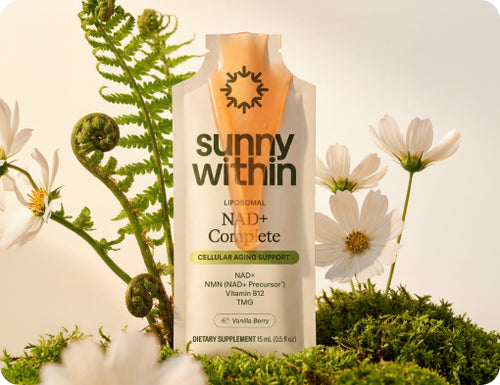
Most NAD+ formulas focus on a single ingredient and leave the methylation side of the pathway to chance. Sunny Within's NAD+ was designed to support the whole pathway in one tasty pouch.
- Direct NAD+ (50mg): Protected inside our waterless liposomal system, direct NAD+ supports your levels right away without waiting on conversion.*
- NMN (400mg): A clinically-studied dose of NMN has been shown to significantly increase blood NAD+ levels at 30 and 60 days, and our 400mg falls within that studied range (Yi et al., 2022).†
- TMG (500mg): This methyl donor helps replenish the methyl groups NMN conversion draws on.*
- Vitamin B12 As Methylcobalamin (300mcg): This highly bioavailable B12 supports the methylation cycle alongside TMG, as well as everyday energy and mental clarity.*
All four ingredients are carried in good fats like organic coconut-derived MCT oil and avocado oil, rather than the cheap processed oils and synthetic emulsifiers many liposomal brands rely on. The result is a light, creamy Vanilla Berry pouch you can squeeze straight into your mouth, with or without food, and every batch is third-party tested.
TMG Dosage: Matching The Amount To The Job
The right TMG dosage depends on what you're asking it to do. Studies focused on lowering homocysteine have often used several grams per day as a standalone protocol, although the meta-analysis above found that smaller daily amounts also helped. Those trials are answering a different question than a formula built around NAD+.
In our NAD+ formula, TMG has a focused role. Namely, it keeps pace with the methyl groups NMN conversion uses. A meaningful 500mg dose fits that job, and pairing it with 300mcg of vitamin B12 supports both of the body's main recycling routes.* Food sources add even more on top. If homocysteine itself is your focus, or you're managing a medical condition or taking prescription medications, it's best to set your TMG amount with your healthcare provider. For a closer look at how much NAD+ support makes sense in the first place, our breakdown of NAD+ dosage per day is a helpful next read.
TMG, Betaine Anhydrous And Other Label Names
TMG goes by several names on supplement labels, which can make shopping confusing. You might see it listed as TMG, trimethylglycine, betaine, or betaine anhydrous, and all of these refer to the same compound. Our NAD+ formula uses betaine anhydrous, also known as trimethylglycine (TMG). TMG is the name on our pack, and betaine anhydrous is simply its water-free form. The one name to watch out for is betaine HCl, which is a distinct compound used to support stomach acid rather than methylation.
How To Choose The Best TMG Supplement
Labels can look nearly identical at a glance, so a few quick checks will help you find the best TMG supplement for your goals:
- Look For A Clear Dose: Choose products that list the exact TMG amount rather than hiding it inside a proprietary blend.
- Confirm Third-Party Testing: Independent lab testing verifies purity, potency, and that each ingredient matches what the label promises.
- Check The Supporting Cast: If TMG is part of an NAD+ formula, look for partners like methylcobalamin that support the same methylation cycle.
- Mind The Delivery Format: When TMG comes paired with fragile nutrients like NAD+, liposomal delivery built on healthy fats helps protect those ingredients through digestion.*
- Scan For Allergens And Fillers: Review the label for tree nuts, dairy, soy, gluten, artificial sweeteners, and any unnecessary additives.
Our guide to life extension supplements walks through how to evaluate any longevity ingredient for quality and fit.
*These statements have not been evaluated by the Food and Drug Administration. This product is not intended to diagnose, treat, cure, or prevent any disease.
† These statements have not been evaluated by the Food and Drug Administration. This product is not intended to diagnose, treat, cure, or prevent any disease. Clinical reference: Yi L, et al. GeroScience. 2022. Study conducted on NMN as a standalone ingredient.
Sources:
- Arumugam, M. K., Paal, M. C., Donohue, T. M., Jr., Ganesan, M., Osna, N. A., & Kharbanda, K. K. (2021). Beneficial effects of betaine: A comprehensive review. Biology, 10(6), 456.
- Ashtary-Larky, D., Bagheri, R., Ghanavati, M., Asbaghi, O., Tinsley, G. M., Mombaini, D., Kooti, W., Kashkooli, S., & Wong, A. (2022). Effects of betaine supplementation on cardiovascular markers: A systematic review and meta-analysis. Critical Reviews in Food Science and Nutrition, 62(23), 6516–6533.
- Yi, L., Maier, A. B., Tao, R., Lin, Z., Vaidya, A., Pendse, S., Thasma, S., Andhalkar, N., Avhad, G., & Kumbhar, V. (2022). The efficacy and safety of β-nicotinamide mononucleotide (NMN) supplementation in healthy middle-aged adults: A randomized, multicenter, double-blind, placebo-controlled, parallel-group, dose-dependent clinical trial. GeroScience, 45(1), 29–43.