Women naturally store 70 to 80 percent less creatine in their muscles than men, partly because of lower muscle mass and partly because women tend to eat less creatine-rich food. Red meat and fish are the primary dietary sources, and even at adequate intake, dietary creatine alone rarely saturates muscles the way supplementation can.
This lower baseline is one of the strongest arguments for supplementation. Research consistently shows that people with lower starting stores see the most pronounced response, which is precisely why creatine benefits for women deserve far more attention than the industry has given them.
Should Women Take Creatine? What the Research Says
The question of whether women take creatine has a clear answer in the research: yes, and the case goes well beyond performance. A landmark 2021 review published in Nutrients, one of the most comprehensive analyses of creatine in women's health to date, concluded that creatine supplementation is both safe and beneficial across the female lifespan. The benefits span strength, body composition, bone health, cognitive function, and mood.
A 2025 meta-analysis confirmed that women who combine creatine with resistance training see significant improvements in both upper- and lower-body strength and peak power output. Strength gains of 10 to 15 percent compared to training alone have been reported across multiple studies, with benefits observed regardless of training experience.
Strength and Performance
Creatine works at the level of cellular energy. It increases the availability of phosphocreatine in muscle cells, which lets the body regenerate ATP, its primary energy currency, faster. That matters in the gym, yes, but it also matters in the brain, which runs on more creatine than almost any other tissue. The same mechanism that helps you push through a hard set is the one that keeps your focus sharp and your energy steady through the rest of the day.*
For women, this translates directly to better training results, and research shows they tend to respond especially well relative to their male counterparts because of that lower baseline.
Creatine for Women Over 40: Muscle, Bone, and Aging
The case for creatine for women over 40 becomes particularly compelling after midlife. Muscle and bone both respond to consistent creatine use. Research in peri- and postmenopausal women shows significantly greater preservation of lean mass, strength, and bone density with creatine plus resistance training compared to training without it. The body is still building and remodeling tissue at every age. Creatine gives it more to work with.*
Creatine does not replace estrogen. But the research suggests it can partially offset the effects of its decline. Women who supplemented with creatine and followed a consistent resistance training program showed significantly greater preservation of lean mass and strength than those who trained without it, across multiple trials in peri- and postmenopausal populations.
The bone findings are equally meaningful. In a 12-month randomized controlled trial, postmenopausal women who combined creatine with resistance training lost approximately 1.2 percent of femoral neck bone density, compared with 3.9 percent in the placebo group. For more on how exercise interacts with long-term health, our article on how regular exercise can extend your lifespan the power of movement for longevity covers the broader picture.
Creatine and Menopause: Brain Health and Energy
The connection between creatine and menopause extends beyond muscle and bone. Roughly 5 percent of the body's total creatine is found in the brain, one of the most energy-demanding organs. Estrogen decline during the menopausal transition appears to reduce the brain's capacity to synthesize and use creatine efficiently, which may contribute to the cognitive symptoms many women report during this period, including brain fog, memory lapses, and reduced processing speed.
A 2018 study published in Psychopharmacology found that creatine supplementation improved working memory and processing speed in women. These findings are early, and more research is needed, but they point toward a neurological role for creatine that is especially relevant to women navigating the hormonal shifts of midlife.
Addressing Creatine Women Weight Gain Concerns
One of the most persistent reasons women avoid creatine is concern about the scale. The question of women's weight gain with creatine is real, but the answer is almost always misunderstood. Creatine draws water into muscle cells through a process called cell volumization. This increases intracellular water, not subcutaneous water, so it does not cause the puffiness or bloating that the term "water retention" typically implies.
Any initial increase in scale reflects muscle hydration, a positive physiological change that supports energy production and improves muscle tone. For most women, this effect is modest, with studies showing initial changes of roughly 0.5 to 1.5 kg, if any at all, and longer-term studies of 5 to 6 weeks show no significant continued increase in total body water. Starting with 3 to 5 grams daily rather than a loading phase minimizes any initial fluctuation.
How to Take Creatine: Practical Guidance
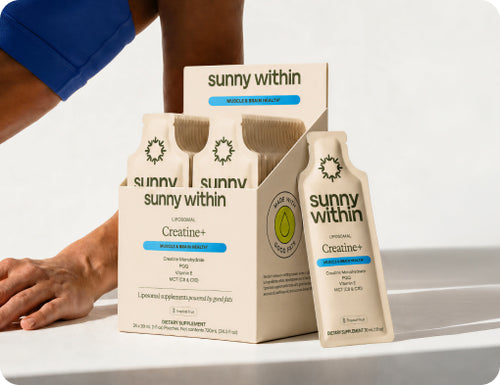
Creatine monohydrate is the most researched form, and daily consistency at 5g is supported by the evidence. Creatine+ delivers that dose in a liposomal pouch alongside PQQ, one of the only compounds shown to trigger the creation of new mitochondria, not just fuel existing ones, and Vitamin E for cellular antioxidant protection. You’re not paying more for a fancier form of creatine. You’re getting a complete cellular energy stack in the same daily habit.*
Creatine+ delivers 5g per pouch, the full dose consistent with the research, taken once daily at any time with or without food. No loading phase, no measuring, no mixing. Creatine stores saturate within 2 to 4 weeks. Deeper benefits, mitochondrial health, cognitive function, muscle preservation, build over 8 to 12 weeks of consistent daily use.* Creatine does not need to be cycled and works best taken consistently every day, including rest days. For a deeper look at how creatine specifically supports performance and health after 35, our article on creatine after 35 covers the age-specific research in detail.
Sunny Within Creatine+ for Women
Sunny Within's Creatine+ delivers liposomal creatine monohydrate alongside PQQ and MCT in an avocado oil-based system, designed for better absorption and easier digestion. At $69 per month, or $55 with a subscription, it fits cleanly into a daily wellness routine.
*These statements have not been evaluated by the Food and Drug Administration. This product is not intended to diagnose, treat, cure, or prevent any disease.
Sources:
- Smith-Ryan AE, Cabre HE, Moore SR. "Creatine Supplementation in Women's Health: A Lifespan Perspective." Nutrients. 2021.
- Gualano B, et al. "Creatine supplementation in the aging population: effects on skeletal muscle, bone and brain." Amino Acids. 2016.
- Candow DG, et al. "Creatine supplementation and bone mineral density in postmenopausal women." Bone. 2008.