Building muscle depends on three things: a training stimulus, adequate protein intake, and sufficient recovery. The right muscle-building supplements do not replace any of those pillars, but they can meaningfully support each one when used at the right doses.
The supplements with the strongest evidence either directly supply building blocks for muscle, amplify the signaling pathways that trigger growth, or improve the quality and volume of training over time. One factor that often gets overlooked is absorption. A supplement with the right ingredient at the right dose still has to survive digestion and reach the target tissue to do anything. That is why delivery format belongs in the conversation alongside ingredients.
The Best Supplements for Muscle Growth
Not all supplements are created equal, and the ones worth your money are the ones that have stood up to repeated, independent clinical testing. Below are the compounds with the strongest evidence for supporting muscle growth, along with the research-backed doses and mechanisms behind each one:
Creatine Monohydrate
Creatine monohydrate is the most researched performance supplement in existence. It works by saturating muscle cells with phosphocreatine, a molecule that regenerates ATP during high-intensity contractions. More available ATP means more reps, more output per set, and greater training volume over time.
Research shows that creatine, combined with resistance training, adds roughly 1.0 to 1.4 kg of lean mass over 8 to 12 weeks compared to training alone. In older adults specifically, a 2017 meta-analysis in the Open Access Journal of Sports Medicine found that creatine, combined with resistance training, increased lean tissue by approximately 1.37 kg more than training without it. Strength effects typically appear within the first 1 to 4 weeks.
The standard maintenance dose is 3 to 5 grams daily. Creatine does not need to be cycled, does not require a specific timing protocol, and has no serious adverse events documented across the research literature. For a closer look at how creatine supports performance, specifically after age 35, our article on creatine after 35 covers the research in detail.
Protein and Leucine
Adequate protein intake is the single most important nutritional variable for muscle growth. A 2018 meta-analysis of 49 randomized controlled trials published in the British Journal of Sports Medicine found that 1.6 to 2.2 grams of protein per kilogram of body weight daily is the threshold that meaningfully supports hypertrophy. Total daily intake matters more than the timing of any individual dose.
The key mechanism is leucine, an essential amino acid that acts as the primary signal for muscle protein synthesis. Leucine activates the mTOR pathway, the central anabolic driver of muscle growth. When leucine concentrations rise after a meal or supplement, mTOR reads that signal as a cue to initiate new protein synthesis. Whey protein is particularly effective because of its high leucine content and rapid digestion profile.
Workout Supplements for Muscle Growth: Caffeine and Beta-Alanine
Some workout supplements for muscle growth do not build muscle directly but support the training conditions that drive muscle adaptation. Caffeine improves power output, reduces perceived exertion, and allows athletes to sustain higher training volumes. A dose of 3 to 6 mg per kilogram of body weight taken 30 to 60 minutes before training is the range most consistently supported by research.
Beta-alanine buffers hydrogen ions that accumulate during high-intensity work, delaying the onset of muscular fatigue. It is most effective for sets lasting 60 to 240 seconds. A standard dose is 3.2 to 6.4 grams daily, with tingling as a harmless and commonly reported side effect.
Supplements for Muscle Gain: Omega-3 Fatty Acids
Omega-3 fatty acids, specifically EPA and DHA, are among the most overlooked supplements for muscle gain. Their primary contribution is reducing systemic inflammation, which is particularly relevant for recovery between training sessions. Research also points to a direct role for omega-3s in supporting muscle protein synthesis, particularly in older adults, whose anabolic response to exercise may be diminished. A dose of 2 to 3 grams of combined EPA and DHA daily is what most supporting research is conducted on. As fat-soluble compounds, they absorb significantly better when taken with a meal containing dietary fat.
Muscle Recovery Supplements: Magnesium
Among the most underrated muscle recovery supplements, magnesium stands out for the breadth of processes it supports, and recovery is where growth actually happens. Women are particularly vulnerable to low magnesium status. Hormonal shifts through perimenopause and beyond disrupt both sleep and magnesium levels at the same time, right when both start to matter more. The combination makes magnesium one of the most impactful recovery nutrients for women over 35, not just for muscle repair but for the quality of sleep where that repair actually happens.* Research has linked adequate magnesium levels to improved sleep latency and more restorative sleep stages, and athletes deplete stores faster through sweat.
Sleep is the most important recovery tool available. During the body’s deepest restorative stages, it releases growth hormone, synthesizes muscle protein, and repairs connective tissue. Consistently poor sleep elevates cortisol and reduces testosterone, two changes that directly work against muscle growth. Magnesium glycinate, 200-400 mg taken in the evening, is a practical and well-tolerated starting point.
Exercise, Recovery, and Long-Term Muscle Health
Consistent training over months and years is the primary variable that produces meaningful changes in body composition and better long-term health outcomes. For a broader look at how movement interacts with lifespan and health markers, our article on how regular exercise can extend your lifespan the power of movement for longevity explores the research in depth.
Best Supplements for Gaining Muscle: What to Look For on a Label
Shopping for the best supplements for gaining muscle comes down to a few reliable habits. Prioritize ingredients with published human trial data. Check that individual doses match the amounts used in clinical research, since proprietary blends that hide ingredient quantities make this impossible to evaluate. Consider the delivery format. Fat-soluble compounds absorb poorly from standard capsules. Liposomal delivery, a technology originally developed for pharmaceutical use in the 1960s, encapsulates nutrients in fat-based bubbles made of phospholipids, the same building blocks as your cell membranes. Most brands use cheap oils or synthetic emulsifiers to make this work. Sunny Within was the first to formulate liposomal supplements with good fats: organic avocado oil and coconut-derived MCT, which support absorption and add meaningful nutritional value on their own.* Verify GMP certification and third-party testing to confirm that label claims reflect actual contents.
How Sunny Within Creatine+ Fits Into a Muscle Growth Stack
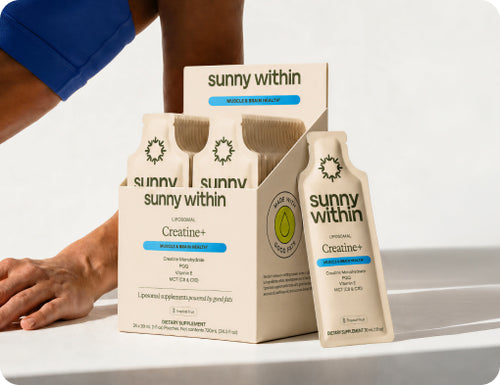
Sunny Within’s Creatine+ is built for longevity, not the gym. It delivers a full 5g clinical dose of creatine monohydrate alongside PQQ, one of the only compounds shown to trigger the creation of new mitochondria, not just fuel existing ones, and MCT from organic sources, all in a liposomal avocado-oil base that bypasses the powder inconsistency that makes most people abandon creatine in the first place.* That combination is why it sits differently than a standard creatine product: the formula is designed for cellular energy, cognitive support, and muscle preservation over time, not a pre-workout bump.
*These statements have not been evaluated by the Food and Drug Administration. This product is not intended to diagnose, treat, cure, or prevent any disease.
Sources:
- Delpino FM, Figueiredo LM, Forbes SC, Candow DG, Santos HO. "Influence of age, sex, and type of exercise on the efficacy of creatine supplementation on lean body mass: A systematic review and meta-analysis of randomized clinical trials." Nutrition. 2022;103:111791.
- Chilibeck PD, et al. "Effect of creatine supplementation during resistance training on lean tissue mass and muscular strength in older adults: a meta-analysis." Open Access Journal of Sports Medicine. 2017.
- Morton RW, et al. "A systematic review, meta-analysis and meta-regression of the effect of protein supplementation on resistance training-induced gains in muscle mass and strength in healthy adults." British Journal of Sports Medicine. 2018.