




Key Takeaways:
- Two Forms of CoQ10: Ubiquinol and ubiquinone are the same molecule in different oxidation states, with differences in how the body uses them.
- Ubiquinol Is the Reduced Form: The body can use ubiquinol directly, while ubiquinone must first be converted.
- Delivery Format Matters: Liposomal CoQ10 is designed to help deliver this fat-soluble nutrient more efficiently than standard capsules or powders.
Have you ever flipped over a CoQ10 bottle and wondered why some labels say "ubiquinol" while others say "ubiquinone" and whether that difference actually matters? You are not alone. The conversation around ubiquinol vs. CoQ10 trips up even health-savvy shoppers, mostly because both names refer to the same foundational molecule but behave quite differently inside the body.
At Sunny Within, our clean, science-backed liposomal supplements are built around one principle: if a nutrient is worth taking, it should actually reach your cells. Understanding the different CoQ10 forms is a meaningful first step toward making that happen. In this piece, we will walk through what separates ubiquinol from ubiquinone, what the research says about each, and how delivery format fits into the bigger picture.
What Is CoQ10, and Why Does It Matter?
CoQ10, short for Coenzyme Q10, is a fat-soluble compound produced naturally by the body and found in virtually every cell. It plays two major roles: supporting ATP production inside the mitochondria and acting as an antioxidant that helps neutralize free radicals and protect cells from oxidative damage.
The heart, liver, kidneys, and muscles rely especially heavily on CoQ10 because they are the body's most energy-demanding tissues. There is an important catch: natural CoQ10 production declines with age, with the most significant drops typically occurring after 40. Statin medications, commonly prescribed for cholesterol management, further deplete CoQ10 levels by blocking the same metabolic pathway the body uses to synthesize it. If you want a deeper look before diving into the comparison, our guide on what is CoQ10 covers the full story.

The Two CoQ10 Forms Explained
CoQ10 exists in two interconvertible states. Understanding them is the key to making a smarter supplement choice.
Ubiquinone: The Oxidized Form
Ubiquinone is the traditional, oxidized form of CoQ10. It is chemically stable, widely available, and generally less expensive. The limitation is that the body must first convert it to ubiquinol before it can be used. In younger, healthy individuals, this conversion happens efficiently. As we age, however, the enzymes responsible for that conversion become less effective, meaning a meaningful portion of supplemental ubiquinone may not be fully utilized.
Ubiquinol: The Active, Reduced Form
Ubiquinol is the reduced, active form of CoQ10. It is the form the body uses directly and makes up roughly 90 to 95 percent of the CoQ10 circulating in healthy plasma. Because it skips the conversion step, ubiquinol is more bioavailable in practice, particularly for adults over 40 whose conversion efficiency has declined. In comparative research, ubiquinol has produced meaningfully higher plasma CoQ10 levels than equivalent doses of ubiquinone, particularly in older adults where the conversion process is less efficient
Ubiquinol vs. Ubiquinone: A Side-by-Side Look
Here is how CoQ10 vs. ubiquinol stacks up across the factors that matter most.
Absorption and Bioavailability
Ubiquinol tends to produce higher, more consistent plasma CoQ10 elevations, particularly in older adults. Ubiquinone's bioavailability varies considerably by formulation. Dry powder capsules are poorly absorbed, whereas oil-based softgels are significantly more effective.
Stability
Ubiquinone has a clear stability advantage, with a longer shelf life and easier manufacturing. Ubiquinol requires more careful formulation due to its sensitivity to light and air.
Cost
Ubiquinone is more affordable. For budget-conscious supplementers who are younger and have healthy metabolic function, it can be a reasonable option in a quality delivery format.
Who Benefits Most
The question of which is better, CoQ10 or ubiquinol, comes down to individual circumstances. Ubiquinol offers a more meaningful edge for adults over 40, individuals on statin medications, or anyone whose conversion ability may be compromised. For younger adults with robust metabolic function, high-quality ubiquinone in the right delivery format can be effective.

Ubiquinol Benefits Worth Knowing
Regardless of which form you choose, the core benefits apply to both, since ubiquinol is ultimately what your body uses.
Cellular Energy Support
CoQ10 is a critical component of the electron transport chain, where it helps convert nutrients into ATP. Tissues with the highest energy demands, like the heart and muscles, depend on adequate CoQ10 levels to function optimally.
Antioxidant Protection
Ubiquinol works within cell membranes as a fat-soluble antioxidant, protecting lipids, proteins, and DNA from oxidative damage. This role becomes more important as natural production declines with age.
Heart Health Support
Research links adequate CoQ10 levels to healthy heart function support, including energy production in cardiac cells and protection of LDL cholesterol from oxidation. CoQ10 is found in high concentrations in cardiac tissue, and declining levels with age have been associated with reduced cardiovascular resilience.*
Support for Statin Users
Because statins block the pathway that produces CoQ10, individuals on these medications often experience a meaningful reduction in CoQ10 levels. Multiple meta-analyses show CoQ10 supplementation supports muscle comfort in people taking statins.*
Why Delivery Format Is Part of the Conversation
How CoQ10 is delivered matters as much as which form it takes. Standard dry powder capsules provide poor bioavailability regardless of form. Oil-based softgels perform better. Liposomal delivery, which encapsulates nutrients in microscopic fat-based vesicles that mirror the body's own cell membranes, is designed to protect the nutrient through digestion and improve cellular uptake.
To understand why liposomal delivery changes the equation, our post on liposomal vs regular supplements breaks it down clearly. And for a closer look at CoQ10 in a liposomal format specifically, our article on liposomal CoQ10 is worth a read.
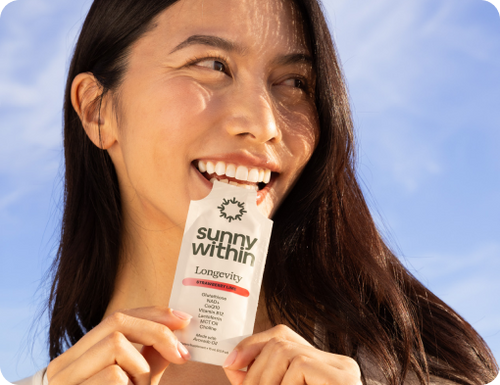
Sunny Within's Longevity formula, available in Strawberry Lime, pairs CoQ10 with NAD+, glutathione, B12, and MCT in a liposomal base made with organic avocado oil, designed to support cellular energy, detox pathways, and healthy aging together.

Final Thoughts
The debate around ubiquinol vs. ubiquinone has a practical resolution: form matters, and so does delivery. Ubiquinol is the active form the body uses directly and tends to offer greater bioavailability, particularly for those whose ability to convert has declined. Ubiquinone remains a solid option in a quality delivery format for younger, healthier adults. For most people, the goal is the same regardless of which name is on the label. Getting enough CoQ10 into the cells that need it most is what counts.
A supplement is only as good as what your cells actually absorb. Choosing a formula built around that principle is the clearest path to results you can actually feel.
Frequently Asked Questions About Ubiquinol and CoQ10
Is ubiquinol the same as CoQ10?
Ubiquinol is a form of CoQ10, not a different supplement. CoQ10 is the umbrella term for the molecule, which exists in two states: ubiquinone (the oxidized form) and ubiquinol (the reduced, active form). Both are CoQ10. They just behave differently depending on how efficiently they are absorbed and converted.
Which is better, ubiquinol or CoQ10?
For most adults, especially those over 40, ubiquinol is generally considered the more bioavailable option because it bypasses the conversion step required for ubiquinone to be used. A high-quality oil-based ubiquinone product can still perform well for younger individuals with healthy metabolic function. Delivery format also plays a significant role in real-world effectiveness.
What is ubiquinone used for?
Ubiquinone supports ATP production in the mitochondria and provides antioxidant protection, the same core functions as all CoQ10 forms. It is the traditional form found in most supplements and carries the most extensive research history.
Does ubiquinol have side effects?
Ubiquinol is well-tolerated by most people. High doses may occasionally cause mild digestive discomfort, nausea, or headache. CoQ10 in any form can interact with blood-thinning medications like warfarin, so checking with a healthcare provider before starting supplementation is always a good idea.
Can you take ubiquinol and ubiquinone together?
Yes, it is safe. The body naturally interconverts both forms continuously as part of normal cellular function. Most CoQ10 supplements, regardless of starting form, will ultimately provide ubiquinol for active use.
How long does it take for CoQ10 to work?
Consistent daily supplementation for 4 to 12 weeks is generally needed to observe meaningful changes in plasma CoQ10 levels and related outcomes.
|
*This statement has not been evaluated by the Food and Drug Administration. This product is not intended to diagnose, treat, cure, or prevent any disease. |
Sources:
- Littarru GP, Tiano L. "Bioenergetic and antioxidant properties of coenzyme Q10: recent developments." Molecular Biotechnology. 2007.
- Bhagavan HN, Chopra RK. "Plasma coenzyme Q10 response to oral ingestion of coenzyme Q10 formulations." Mitochondrion. 2007.
- Pravst I, et al. "Bioavailability of Coenzyme Q10: An Overview of the Absorption Process and Subsequent Metabolism." Antioxidants (MDPI). 2020.
- Medical News Today. "CoQ10: Benefits, side effects, and dosage." medicalnewstoday.com.

