



Key Takeaways:
- NAD+ And NMN Target The Same Pathway From Different Directions: NAD+ is the active molecule cells use directly, while NMN is a precursor the body converts into NAD+, and understanding that distinction clarifies why the two are often discussed together.
- The Research Behind Both Molecules Is Growing: Studies on NAD+ and NMN span energy metabolism, cellular repair, and metabolic health, with human trials increasingly backing up what was once mostly animal research.
- Delivery Format Shapes What Your Cells Receive: Getting these molecules to the cell intact matters just as much as the molecules themselves, which is part of why delivery format has become its own area of interest.*
NAD+ and NMN appear in the same longevity research, but they play distinct roles in the body. That matters when you're trying to understand what either one is doing for you.
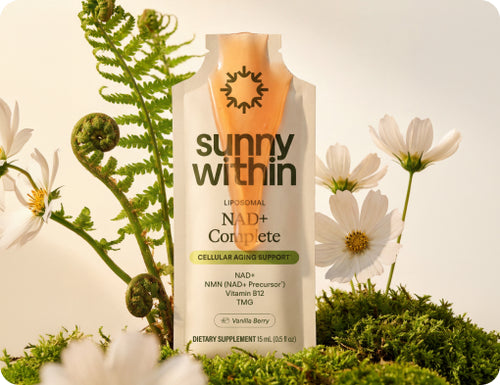
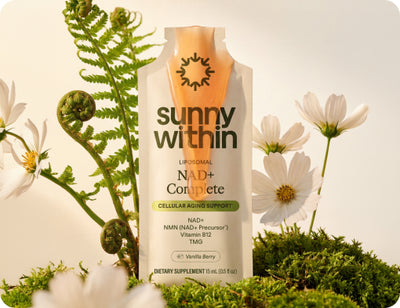
Basically, NAD+ is the active form your cells use directly, while NMN is a precursor that the body converts into NAD+ through a natural pathway. At Sunny Within, our NAD+ is built around both because the science behind combining them is worth figuring out before deciding how to supplement.
In this article, we cover how each works, what current research shows about the respective NMN and NAD+ benefits, and how they interact when used together.

The NAD+ And NMN Connection: How The Two Molecules Relate
NAD+ and NMN sit at different points in the same metabolic chain. NAD+ (nicotinamide adenine dinucleotide) is the endpoint: the coenzyme that powers energy production, activates repair enzymes, and supports cellular processes the body depends on. NMN (nicotinamide mononucleotide) arrives a step earlier. Once inside a cell, it’s converted to NAD+ through a natural enzymatic process, adding to the available pool rather than acting on its own.
The term "precursor" simply describes a compound that the body converts into something else naturally. NMN is one of several NAD+ precursors studied in longevity research, and it has drawn particular attention because it enters cells efficiently and converts to NAD+ at a meaningful rate.* That makes it a practical route to support NAD+ availability, one that complements direct NAD+ supplementation rather than replacing it outright.
NAD+ Benefits Your Body Relies On
The research on NAD+ benefits spans multiple biological systems, but a consistent picture has emerged. This molecule is deeply embedded in how cells generate energy, respond to stress, and maintain genetic material over time, and understanding what it does at that level clarifies why supporting it has become a priority in longevity science.
How NAD+ Fuels The Mitochondrial Energy Cycle
Let’s start with a fundamental question. What is an NAD+ supplement? In simple terms, it's a supplement designed to support the body's NAD+ pool, either by delivering the molecule directly, supplying a precursor like NMN that the body converts into NAD+, or both. That pool matters because of what NAD+ does once it's there.
Namely, mitochondria depend on NAD+ as an electron carrier in the reactions that produce adenosine triphosphate (ATP), the energy currency cells run on. As NAD+ availability falls with age, research suggests mitochondrial efficiency declines alongside it.* The downstream effects touch a wide range of functions, which is one reason NAD+ has sustained the attention of researchers focused on healthy aging.
Sirtuins, PARPs, And What They Depend On
NAD+ is also required by two enzyme families that sit at the center of most of this research: sirtuins, which regulate gene expression and stress responses, and poly (ADP-ribose) polymerases (PARPs), which detect and repair DNA strand breaks. Imai and Guarente (2014) reviewed the relationship between NAD+ and sirtuins specifically, describing how sirtuin activity depends directly on adequate NAD+ availability, and how that relationship connects to broader questions about aging and disease.*

NMN Benefits And What The Research Suggests
NMN entered the longevity conversation largely because of its role as a precursor, but the research on NMN benefits has grown substantially on its own terms. Human trials have moved beyond animal studies in recent years, and several findings now speak directly to what oral NMN supplementation can do.
What Human Studies Show About NMN
Mills et al. (2016) found that long-term NMN administration in aged mice mitigated several markers of age-associated physiological decline, tying those effects to the restoration of NAD+ levels. More recently, human research has caught up. Yi et al., (2022) showed in a randomized, double-blind, placebo-controlled study that NMN significantly increased blood NAD+ levels in healthy adults aged 40–65 at both 30 and 60 days. These findings don't confirm longevity outcomes in people, and it's worth being upfront about that gap, but they do point consistently toward NMN's role in supporting cellular NAD+ availability.
NAD And NMN Benefits Compared
Comparing NAD and NMN benefits side by side comes down to timing and mechanism rather than one molecule being categorically better than the other. NAD+ acts at the cellular level immediately, since it's already the finished coenzyme cells use. Meanwhile, NMN replenishes the NAD+ pool from upstream through a natural conversion process, which takes a bit longer to show up but adds to the body's own production capacity rather than just supplying a fixed dose. With that in mind, neither approach is inherently more valuable than the other. Rather, they're addressing the same underlying goal of maintaining adequate NAD+ availability through two different mechanisms.
Taking NAD+ And NMN Together: A Closer Look At Synergy
The rationale for using NAD+ and NMN together rests on that same complementary relationship. NAD+ can support more immediate cellular availability, while NMN works to replenish the pool over time through the body's own biosynthesis pathway. Used together, the two offer broader coverage of the NAD+ system than either one alone, since they're addressing supply from two specific directions rather than duplicating the same effect.
If you're thinking through the practical side of this, timing and dosage both matter. Our guide on the best time to take NAD+ walks through what the research suggests about when supplementation may be most effective, and our breakdown of NAD+ dosage per day goes deeper into our own highly bioavailable supplement. As with any supplement intended for regular use, it's worth discussing dosage and timing with a healthcare provider before making changes to your routine.

Final Thoughts
NAD+ and NMN are distinct molecules that serve the same underlying function: keeping the cellular NAD+ pool at a level where energy production, DNA repair, and cellular defense can operate the way they're meant to. As human trial data has continued to accumulate, the case for understanding both molecules, rather than focusing on just one, has grown stronger. Whether that translates into supplementing with one, the other, or both really comes down to your own goals and what your healthcare provider recommends for your specific situation.
Frequently Asked Questions About NAD+ Benefits
What are NAD+ benefits?
NAD+ is central to cellular energy production, fuels PARP enzymes during DNA repair, and enables sirtuin proteins linked to stress responses. These functions are part of why supporting NAD+ levels has become a priority in longevity research.
What are the top NAD+ benefits specifically?
NAD+ benefits include supporting mitochondrial ATP production, enabling PARP-mediated DNA repair, and activating sirtuins that regulate how cells respond to stress. Maintaining NAD+ availability supports cellular efficiency as natural levels decline with age.
What are NMN benefits?
NMN benefits are tied to its role as a NAD+ precursor. To be specific, human studies have shown oral NMN can raise plasma and muscle NAD+ levels.
Does taking NAD+ and NMN together make a meaningful difference?
The evidence suggests they work through complementary rather than redundant mechanisms, so combining them offers broader coverage of the NAD+ system. Long-term outcome data in people is still developing.
Is NMN research based mostly on animal studies or human studies?
Both, at this point. Early evidence came primarily from animal research, but more recent human trials have shown measurable effects on markers like muscle NAD+ levels and insulin sensitivity.
What makes liposomal delivery relevant to NAD+ and NMN supplementation?
Liposomal delivery wraps active ingredients in a lipid layer resembling a cell membrane, which supports more direct cellular absorption. For molecules like NAD+ and NMN, the delivery format can influence how much reaches circulation intact.*
|
*This statement has not been evaluated by the Food and Drug Administration. This product is not intended to diagnose, treat, cure, or prevent any disease. |
Sources:
- Imai, S., & Guarente, L. (2014). NAD+ and sirtuins in aging and disease. Trends in cell biology, 24(8), 464–471. https://doi.org/10.1016/j.tcb.2014.04.002
- Mills, K. F., Yoshida, S., Stein, L. R., Grozio, A., Kubota, S., Sasaki, Y., Redpath, P., Migaud, M. E., Apte, R. S., Uchida, K., Yoshino, J., & Imai, S. (2016). Long-term administration of nicotinamide mononucleotide mitigates age-associated physiological decline in mice. Cell Metabolism, 24(6), 795–806.
- Yoshino, M., Yoshino, J., Kayser, B. D., Patti, G. J., Franczyk, M. P., Mills, K. F., Sindelar, M., Pietka, T., Patterson, B. W., Imai, S., & Klein, S. (2021). Nicotinamide mononucleotide increases muscle insulin sensitivity in prediabetic women. Science, 372(6547), 1224–1229.

