



Key Takeaways:
- Your NAD+ Levels Drop By Up To 50% Between Your Twenties And Fifties: NAD+ runs cellular energy production, DNA repair, and the enzymes tied to healthy aging, which is why supporting those levels is one of the most actively studied questions in longevity science.
- Most NAD+ Never Makes It To Your Cells: NAD+ is a large, fragile molecule that breaks down in the digestive tract, so most brands skip it and use a precursor instead. IV drips get around digestion, but an appointment is not a daily habit, and daily is what the research measures.
-
The Better Approach Runs Both Routes At Once: Direct NAD+ protected by liposomal delivery, plus NMN at a clinically-studied dose shown to significantly increase blood NAD+ levels in healthy adults at 30 and 60 days.†
NAD+ has become one of the most studied molecules in longevity science. It was understood for decades as a quiet cofactor in cellular metabolism. It's now recognized as a central player in how cells produce energy, repair themselves, and hold their function over time.*
What hasn't kept up is how it gets into the body. Most of what's sold as NAD+ support either breaks down before it reaches your cells, or requires a clinic appointment, and neither of those is a plan you can keep for a decade.
So this article covers three things: what the research actually shows about NAD+ and aging, where the common approaches to supplementing it fall short, and what a more complete approach looks like.
What The Science Tells Us About NAD+ And Aging
NAD+ (nicotinamide adenine dinucleotide) is present in every living cell you have. It has two jobs that matter here. It shuttles electrons in the reactions that turn food into usable energy, and it fuels the enzymes that maintain and repair your cells.
The enzymes that depend on it
NAD+ is required for the activity of sirtuins, a family of enzymes that regulate cellular stress responses and gene expression. It also powers the polymerases known as PARPs, which are essential to DNA repair (Covarrubias et al., 2021).* Those systems don't run on goodwill. They run on available NAD+, and they slow down when there isn't enough of it to go around.
What happens to your levels over time
NAD+ levels drop by up to 50% between your twenties and fifties, and the trend continues from there.* The interesting part is why. Schultz and Sinclair (2016) looked at this specifically and pointed to increased activity of the enzymes that consume NAD+ as the major contributor, rather than the body simply producing less of it.
That's a meaningful distinction. It means the question isn't only how to make more, it's how to keep enough available for the systems that need it. For the broader picture of what this means for how cellular aging works, we covered that ground separately.
What the research does and doesn't establish
Here's the honest state of play. The decline is well documented. The mechanisms connecting NAD+ to cellular energy, DNA repair, and sirtuin activity are well described. Rajman et al. (2018) reviewed the in vivo evidence and found lifespan-related effects tied to NAD precursor supplementation in animal models. In humans, Yoshino et al. (2018) reviewed the biology of NAD+ intermediates and found that oral nicotinamide mononucleotide (NMN), a precursor your body converts into NAD+, can raise plasma NAD levels in people.
What long-term human outcome data will eventually show is still being worked out. We'd rather say that plainly than dress it up. What is established, and what the rest of this article is about, is that you can raise blood NAD+ levels with the right ingredient at the right dose, and that most products fail at exactly that step.

Why Most NAD+ Supplementation Falls Short
Three common approaches, three different failure points.
The capsule problem
NAD+ is a large, fragile molecule. In a standard capsule or tablet, it typically breaks down in the digestive tract before it ever reaches a cell. This isn't a fringe concern. It's the reason most brands don't include direct NAD+ at all and reach for a precursor instead, because precursors are more stable in standard formats.*
Which leads to the thing nobody tells you on the label: a 300mg dose that breaks down in digestion delivers less than a smaller dose that arrives protected. Label dose and delivered dose are two different numbers, and only one of them matters.
The precursor-only problem
Precursors work, and NMN in particular is well studied. But most formulas stop there, and a precursor has to be converted before your body can use it. NR (nicotinamide riboside) takes two conversion steps. NMN takes one and has its own dedicated cellular transporter, which makes it the more direct of the two.
The part that gets skipped: that conversion draws on your body's methyl groups, and methyl groups are a limited resource. Without replenishment, the cycle becomes less efficient over time. Most NAD formulas include no methylation support at all, which means the ingredient you paid for is working against a bottleneck.
The IV problem
IV NAD+ does solve the digestion question by going around it entirely. The trouble is everything else. It's a clinic appointment, which means it happens when you can book it, not when your cells need it. Human research on NMN measured blood NAD+ at 30 and 60 days of daily supplementation, and the deeper cellular benefits are the ones that build over months of consistency. A protocol you follow every morning is a different kind of thing than one you follow when there's an opening in the calendar.
There's also the question of whether a supplement routine should require leaving the house. We think the answer is no.

A Better Approach: Both Routes At Once
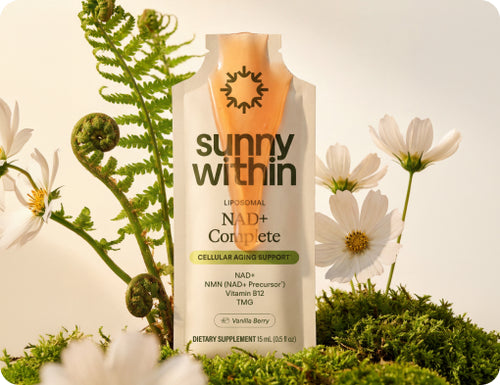
If the failure points are digestion, conversion, and consistency, the fix addresses all three. That's what NAD+ Complete was built to do: deliver NAD+ directly, support your body's own production of it, and make the whole thing a pouch you open in the kitchen.
Direct NAD+, protected on the way down
50mg of direct NAD+ delivered through a waterless liposomal system. Liposomes are made of phospholipids, the same building blocks as your cell membranes, so they shield what's inside from stomach acid and digestive enzymes and then fuse with the cells of the intestinal wall to deliver it.* That protection is the reason we can include direct NAD+ at all, alongside a precursor, without sacrificing stability.
Ours is carried in good fats, organic coconut-derived MCT oil and avocado oil, rather than the cheap processed oils and synthetic emulsifiers most liposomal formulas rely on.
NMN at a clinically-studied dose
400mg of NMN, which falls within the effective range used in human research. In a randomized, double-blind, placebo-controlled study, a clinically-studied dose of NMN significantly increased blood NAD+ levels in healthy adults aged 40 to 65 at both 30 and 60 days (p≤0.001).†
Direct NAD+ and NMN are not redundant. Direct NAD+ skips conversion and delivers the finished molecule. NMN enters cells through its own transporter and replenishes your body's own production. One is delivery, the other is capacity, and running both is more complete than either alone.*
The methylation piece almost everyone skips
500mg of TMG (trimethylglycine) to restore the methyl groups NMN conversion draws on, plus 300mcg of vitamin B12 as methylcobalamin, the most bioavailable form, which works as a direct cofactor in the same methylation cycle.* This is the least glamorous part of the formula and arguably the most important one. It's what keeps the NMN doing its job instead of stalling out.
What to expect, and when
One pouch daily, with or without food. Vanilla Berry, light and creamy, straight into your mouth or stirred into something cold.
Some people notice more energy and sharper focus in the first few days.* NAD+ levels build over weeks, and in clinical research on NMN, healthy middle-aged adults showed significant increases in blood NAD+ at both 30 and 60 days.† The deeper benefits, DNA repair support, cellular resilience, and skin quality, develop over 8 to 12 weeks of consistent daily use.* Third-party tested, vegetarian, contains honey.
What Else Supports Your NAD+ Levels
A pouch works best inside a life that's already pointed in the same direction. A few habits that support your body's own NAD+ production:
Move hard enough to matter. Resistance training and high-intensity exercise have been shown in research to stimulate the pathways your body uses to produce NAD+ naturally.*
Eat for the cellular environment. Whole foods and balanced nutrients support the system NAD+ operates inside.
Protect your sleep. Much of your cellular repair happens overnight, and quality sleep supports many of the same systems NAD+ maintains.
Supplement with intention. Supporting NAD+ levels directly complements these habits rather than replacing them. Our guide to how much to take daily covers the practical side, and if you want the everyday version of what these mechanisms feel like, we wrote about what NAD+ does for energy too.

Final Thoughts
The science on NAD+ and longevity is still being written, but the direction has held steady for years. NAD+ sits at the center of how cells make energy and repair themselves, the decline that comes with age is well documented, and human research shows that the right precursor at the right dose raises blood NAD+ levels.
Where most products lose the thread is delivery. A number on a label means nothing if the molecule doesn't survive the trip, and a clinic drip means nothing on the mornings you don't go. Protect the NAD+, supply the precursor, support the methylation cycle that connects them, and make it something you can actually do every day. That's the whole idea behind NAD+ Complete.
Frequently Asked Questions About NAD+ And Longevity
What is NAD+ and why does it matter for longevity?
NAD+ is a coenzyme found in every cell. Your body uses it to produce energy, repair DNA, regulate metabolism, and respond to cellular stress. Research connects declining NAD+ levels to many of the biological changes that come with age, which is why supporting those levels has become one of the most direct levers in healthy aging.*
Do NAD+ levels decline with age?
Yes. NAD+ levels drop by up to 50% between your twenties and fifties. Schultz and Sinclair (2016) found that the main driver is increased activity of the enzymes that consume NAD+, not just reduced production.
What's the difference between NAD+, NMN, and NR?
Different points on the same pathway. NR converts to NMN, then to NAD+, so two steps. NMN is one step away and has its own dedicated cellular transporter. Direct NAD+ skips conversion entirely. Most formulas pick one. NAD+ Complete uses all three layers: direct NAD+ for delivery, NMN as a clinically-studied precursor, and TMG plus B12 to keep the conversion cycle running efficiently.*
Why is your direct NAD+ dose 50mg when some brands offer 300mg?
Because the dose on the label and the dose your cells receive are different numbers. A 300mg dose that breaks down in digestion delivers far less than a smaller dose that's protected and absorbed. Our waterless liposomal system shields NAD+ through digestion, and we paired it with a clinically-studied dose of NMN so you're supporting your body's own production at the same time. Two mechanisms, not one bigger number.*
How does this compare to Longevity?
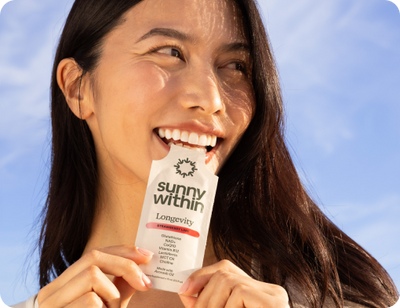
They're built for different goals and designed to work together. Longevity is a total-body healthy aging stack led by glutathione and CoQ10, with NAD+ as one of six ingredients. NAD+ Complete is for the person focused specifically on optimizing the NAD+ pathway from production through utilization.*
Is NAD+ supplementation backed by human research or mostly animal studies?
Both, to different degrees. Much of the lifespan-related evidence comes from animal models. On the human side, a randomized, double-blind, placebo-controlled study found that a clinically-studied dose of NMN significantly increased blood NAD+ levels in healthy adults aged 40 to 65 at 30 and 60 days.† Long-term human outcome data is still developing.
Are there lifestyle habits that support NAD+ levels without supplementation?
Yes. Resistance training, high-intensity exercise, and time-restricted eating have all been associated in research with supporting your body's natural NAD+ production. They work alongside supplementation rather than replacing it.
Should I talk to a doctor before taking NAD+?
It's worth a conversation if you're pregnant, nursing, managing a medical condition, or have a history of cancer. Otherwise NMN has been studied in human trials at doses up to 1,200mg daily with no adverse effects, and every ingredient in our formula is well tolerated at the doses included.*
*These statements have not been evaluated by the Food and Drug Administration. This product is not intended to diagnose, treat, cure, or prevent any disease.
† These statements have not been evaluated by the Food and Drug Administration. This product is not intended to diagnose, treat, cure, or prevent any disease. Clinical reference: Yi L, et al. GeroScience. 2022. Study conducted on NMN as a standalone ingredient.
Sources:
- Covarrubias, A. J., Perrone, R., Grozio, A., & Verdin, E. (2021). NAD+ metabolism and its roles in cellular processes during ageing. Nature Reviews Molecular Cell Biology, 22(2), 119-141. https://doi.org/10.1038/s41580-020-00313-x
- Rajman, L., et al. (2018). Therapeutic potential of NAD-boosting molecules: The in vivo evidence. Cell Metabolism, 27(3), 529-547.
- Schultz, M. B., & Sinclair, D. A. (2016). Why NAD+ declines during aging: It's destroyed. Cell Metabolism, 23(6), 965-966.
- Yi, L., et al. (2022). The efficacy and safety of β-nicotinamide mononucleotide (NMN) supplementation in healthy middle-aged adults. GeroScience.
- Yoshino, J., et al. (2018). NAD+ intermediates: The biology and therapeutic potential of NMN and NR. Cell Metabolism, 27(3), 513-528.

