




Key Takeaways:
- Up to 80% better absorption: Across multiple human trials, liposomal vitamin C delivered 20-80% higher absorption than traditional supplement forms.
- Liposomal Technology Wraps Vitamin C In A Protective Layer: A lipid-based coating is meant to help shield the active ingredient through digestion, which supports more efficient uptake than a traditional capsule or powder.*
- Bioavailability Is The Deciding Factor: How much of what you take reaches your cells matters more than the dose printed on the label, and that's exactly the gap liposomal delivery is designed to close.*
Vitamin C is one of the most familiar nutrients on the shelf, which can be part of the problem. Familiarity tends to make people assume that taking it is enough, without stopping to think about whether the form they're using lets their body absorb it well.
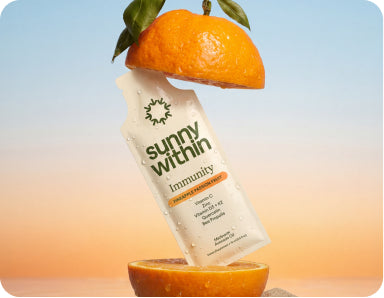
At Sunny Within, we believe the delivery method is where the real difference is made. Our Immunity formula delivers its 750mg of Vitamin C through liposomal encapsulation built on organic avocado oil, so it supports absorption in a way that standard Vitamin C can't replicate.
So, is liposomal Vitamin C better? This article walks through how Vitamin C behaves in the body, what sets liposomal forms apart from regular ones, and what the research suggests about which approach might offer more value depending on your goals.

How Your Body Handles Vitamin C
Vitamin C is a water-soluble nutrient that the body can't produce on its own, so everything your cells use has to come from food or supplementation. The biggest challenge has never been access. It's how efficiently the body can process what you give it. The thing is, Vitamin C plays a role in far more than immune support. Research suggests it helps support collagen synthesis, acts as an antioxidant against everyday oxidative stress, and contributes to the kind of cellular resilience that matters more as you get older.*
Vitamin C Bioavailability And Why The Gap Exists
Vitamin C bioavailability refers to how much of the nutrient makes it into circulation and reaches the cells that need it, rather than how much you swallow. This distinction is the whole reason the absorption conversation exists in the first place. A large dose that mostly gets excreted isn't doing the same work as a smaller dose that's efficiently absorbed, which is why bioavailability, not dose size, tends to be the more useful thing to pay attention to when comparing supplement forms.
Liposomal Vitamin C vs. Regular Vitamin C
The difference between liposomal vitamin C and regular vitamin C comes down to how each one gets in, not to the vitamin C itself. Both cross the intestinal wall. They just arrive very differently.
Regular vitamin C is water-soluble, so it depends on a limited set of dedicated transporters in the gut lining to carry it across. Those transporters can only move so much at a time. Take a larger dose and the extra sits and waits, then leaves the body without ever getting in.
Liposomal vitamin C arrives wrapped in a phospholipid shell, the same material your own cell membranes are made of. That shell shields it from stomach acid and digestive enzymes on the way down. When it reaches the intestinal wall, the cells recognize the shell as their own material and fuse with it, taking the vitamin C in directly instead of waiting for a transporter. More of it also travels through the lymphatic system rather than heading straight to the liver. Liposomal vitamin C ends up roughly 80% more absorbable than non-liposomal.*
None of this makes regular vitamin C useless. It means that the bigger the dose, the more the delivery method decides how much of it you actually get. That's why every drop of vitamin C in Daily Defense is liposomal, carried in organic avocado oil rather than a cheap processed one. For a closer look at how the two forms compare on absorption, use cases, and everyday practicality, we broke it down side by side here.
How Liposomal Vitamin C Absorption Works
Standard Vitamin C has a well-documented absorption ceiling. As the dose increases, the percentage that enters the bloodstream declines, and whatever the body can't absorb gets excreted rather than used. Padayatty et al. (2004) found this saturation effect clearly in their work on Vitamin C pharmacokinetics, showing that oral dosing has a natural limit on how much circulates in the blood, no matter how much you take.
This is the specific gap liposomal delivery was designed to address. So, what is a liposomal? Essentially, liposomal Vitamin C surrounds the active ingredient with a lipid layer that resembles human cell membranes, which helps it pass through the digestive tract with less breakdown along the way. Research looking specifically at liposomal-encapsulated ascorbic acid has found that this encapsulation can meaningfully influence how much Vitamin C becomes available in the body compared to standard, non-encapsulated forms (Davis et al., 2016).

Liposomal Vitamin C Benefits Worth Understanding
The liposomal Vitamin C benefits that research points to are largely tied to the delivery mechanism itself rather than to some entirely different nutrient. Because more of the Vitamin C reaches circulation intact, the downstream effects, like antioxidant support and the role Vitamin C plays in collagen production, can be more consistent over time compared to a form that's partially lost to digestion before it's absorbed.* For a deeper look at the specific perks tied to this delivery method, our article on liposomal Vitamin C benefits covers that ground in more detail.
Consistency also plays a role that's easy to overlook. Vitamin C works well alongside other antioxidant-supporting nutrients, and some research suggests it helps the body maintain glutathione levels, making it a natural pairing in a broader daily routine.* Because liposomal Vitamin C is designed to support absorption whether your stomach is full or empty, it tends to offer more flexibility around timing than standard forms, which can make it easier to stay regular with.
Is Liposomal C Worth It?
Whether liposomal Vitamin C is worth it really depends on what you're looking for. If your goal is simply meeting a baseline daily requirement, a standard supplement can reasonably serve that purpose. But if your goal is to get your body to use more of what you're taking, the liposomal approach offers a meaningful advantage. People who want to support long-term cellular health, whose diets don't typically include Vitamin C-rich foods, or who are looking for a cleaner, more bioavailable supplement form tend to find the liposomal approach most relevant to their goals.

Final Thoughts
Whether liposomal Vitamin C is better than regular Vitamin C comes down to a question about delivery, not the nutrient itself. Standard Vitamin C remains a reliable, well-understood option that most people already know, whereas liposomal Vitamin C takes that same active ingredient and pairs it with a delivery system designed to help more of it reach your cells. Neither form is wrong, but if you want your body to use more of what you're taking, liposomal is the one built for that job.
Frequently Asked Questions About Whether Liposomal Vitamin C Is Better
What does liposomal mean in a supplement?
Liposomal refers to a delivery method that wraps the active ingredient in a lipid layer similar to a cell membrane. This layer is designed to help the nutrient survive digestion and support more direct entry into cells.
Can I take liposomal Vitamin C every day?
Liposomal Vitamin C is generally formulated for daily use. As always, it's worth talking with a healthcare provider about what dosage and routine make sense for you personally.
Does liposomal Vitamin C need to be taken with food?
Because it's already lipid-based, liposomal Vitamin C is designed to support absorption with or without food, which gives you more flexibility than standard Vitamin C typically allows.
Is liposomal Vitamin C more expensive than regular Vitamin C?
Usually, yes. Liposomal formulas tend to cost more than a standard tablet or powder because of the additional encapsulation process involved. Whether that added cost is worthwhile comes back to the same question this article started with: how much of what you're taking your body can use.
Can I combine liposomal Vitamin C with other supplements?
Yes. Vitamin C is commonly paired with other antioxidant or immune-supporting nutrients, and liposomal delivery doesn't change that. As with any combination, it's worth checking with a healthcare provider about what fits your specific routine.
Is liposomal Vitamin C safe?
Vitamin C is generally considered safe and well-tolerated, and liposomal forms use the same active ingredient wrapped in a food-grade lipid layer. That said, it's still worth consulting a healthcare provider before adding any new supplement to your routine.
|
*This statement has not been evaluated by the Food and Drug Administration. This product is not intended to diagnose, treat, cure, or prevent any disease. |
Sources:
- Carr, A. C., & Maggini, S. (2017). Vitamin C and Immune Function. Nutrients, 9(11), 1211. https://doi.org/10.3390/nu9111211
- Padayatty, S. J., Sun, H., Wang, Y., Riordan, H. D., Hewitt, S. M., Katz, A., Wesley, R. A., & Levine, M. (2004). Vitamin C pharmacokinetics: implications for oral and intravenous use. Annals of internal medicine, 140(7), 533–537. https://doi.org/10.7326/0003-4819-140-7-200404060-00010
- Davis, J. L., Paris, H. L., Beals, J. W., Binns, S. E., Giordano, G. R., Scalzo, R. L., Schweder, M. M., Blair, E., & Bell, C. (2016). Liposomal-encapsulated Ascorbic Acid: Influence on Vitamin C Bioavailability and Capacity to Protect Against Ischemia-Reperfusion Injury. Nutrition and metabolic insights, 9, 25–30. https://doi.org/10.4137/NMI.S39764
