Mitochondria are the organelles responsible for converting nutrients into ATP, the molecule that powers cellular processes from muscle contraction to DNA repair. The heart, brain, muscles, and liver all rank among the highest consumers of mitochondrial energy. When mitochondrial function declines, the downstream effects are wide-ranging: reduced physical energy, slower recovery, cognitive fog, and diminished cellular repair capacity.
A key driver of this decline is age-related oxidative damage. Mitochondria are the primary site of reactive oxygen species production in the cell, and over time, accumulated oxidative stress impairs their efficiency and reduces their numbers. Supporting mitochondrial health means both protecting existing mitochondria from damage and encouraging the formation of new ones through a process called mitochondrial biogenesis. Choosing the right mitochondria supplement means targeting both sides of that equation.
CoQ10: The Electron Transport Chain Essential
Coenzyme Q10 is one of the most fundamental mitochondrial support compounds in the human body. It functions as an electron carrier within the inner mitochondrial membrane, shuttling electrons through the electron transport chain to drive ATP synthesis. Without adequate CoQ10, this process slows, and cellular energy output falls.
CoQ10 also functions as a fat-soluble antioxidant, protecting the mitochondrial membrane from the oxidative damage that is an unavoidable byproduct of energy production. This dual role makes it uniquely positioned in this category: it is both a structural participant in ATP synthesis and a protective agent for the system that produces it.
Natural CoQ10 production declines with age. Research has associated this decline with increased oxidative burden and reduced mitochondrial efficiency, effects that tend to become clinically relevant in midlife.* Statin medications, among the most commonly prescribed drugs globally, further deplete CoQ10 by blocking the same biosynthetic pathway. For a thorough overview of what this molecule does and why it matters, our article on what is CoQ10 covers the full picture.
PQQ: Mitochondrial Biogenesis and Antioxidant Power
Pyrroloquinoline quinone, or PQQ, is a vitamin-like compound that has emerged as one of the most promising agents for mitochondrial health. Its primary distinction from CoQ10 is its role in mitochondrial biogenesis, the creation of new mitochondria. Cellular research has shown PQQ activates PGC-1 alpha, the master regulator of mitochondrial biogenesis, through pathways involving SIRT1 and the transcription factors NRF-1 and NRF-2 (Chowanadisai et al., Journal of Biological Chemistry, 2010).
In human subjects, PQQ supplementation has been shown to alter markers of inflammation and mitochondrial-related metabolism. The 2013 Harris et al. study in the Journal of Nutritional Biochemistry found significant effects in adults at dietary intake levels.* PQQ also acts as a highly efficient antioxidant, capable of undergoing thousands of redox cycles without degradation, compared to the one to two cycles typical of most dietary antioxidants. This makes it particularly effective at neutralizing the reactive oxygen species generated during mitochondrial energy production.
PQQ and CoQ10 are synergistic rather than redundant. CoQ10 maintains existing mitochondrial efficiency while PQQ promotes the growth of new mitochondria. Research combining both compounds has shown greater support for energy and cognitive function than either compound produced independently.
NAD+: The Master Regulator of Mitochondrial Metabolism
NAD+ (nicotinamide adenine dinucleotide) sits at the center of mitochondrial metabolism. It functions as the primary electron acceptor in glycolysis and the citric acid cycle, shuttling electrons to the electron transport chain where ATP is ultimately produced. Without adequate NAD+, the entire mitochondrial energy production chain is compromised.
NAD+ also activates sirtuins, a family of proteins that regulate mitochondrial biogenesis, DNA repair, and the cellular stress response. Sirtuin activity depends directly on NAD+ availability, which is one reason why declining NAD+ with age has such broad metabolic consequences. NAD+ levels are estimated to drop by up to 50% between your twenties and fifties, a decline that coincides with fatigue, reduced stamina, and cognitive changes many people attribute to aging.*
NMN (nicotinamide mononucleotide) and NR (nicotinamide riboside) are the most studied NAD+ precursors. Human trials have confirmed that both significantly raise blood NAD+ levels. In a randomized, double-blind, placebo-controlled study, a clinically studied dose of NMN significantly increased blood NAD+ levels in healthy adults aged 40 to 65 at both 30 and 60 days.† For a closer look at how NAD+ supports energy and healthy aging, our article on the benefits of NAD boost your energy and support healthy aging covers the research in detail.
What Makes the Best Supplement for Mitochondria
No single compound covers all aspects of mitochondrial function. CoQ10, PQQ, and NAD+ each target distinct but complementary aspects. CoQ10 supports electron transport and protects membranes. PQQ drives biogenesis and provides antioxidant coverage. NAD+ fuels the metabolic pathways that produce ATP and activates the regulatory proteins that govern mitochondrial health. Together, they address energy production, protection, and biogenesis simultaneously.
Delivery format is equally important. CoQ10 is fat-soluble and absorbs poorly in dry powder capsule form. NAD+ precursors face absorption challenges of their own. Liposomal delivery, which encapsulates nutrients in phospholipid vesicles that mirror the body's own cell membranes, is designed to improve absorption and protect them during digestion.
Why These Three Work Together
The combination of CoQ10, PQQ, and NAD+ represents a layered approach to cellular energy support. NAD+ provides metabolic fuel and activates regulatory proteins that control mitochondrial maintenance. PQQ stimulates the creation of new mitochondria and protects existing ones from oxidative damage. CoQ10 keeps the electron transport chain running efficiently. Addressing mitochondrial health supplements from all three angles is more effective than targeting any one mechanism in isolation. For a broader look at how supporting cellular health connects to long-term vitality, our article on life extension supplements explores the intersection of cellular biology and healthy aging.
How Sunny Within Addresses Mitochondrial Support
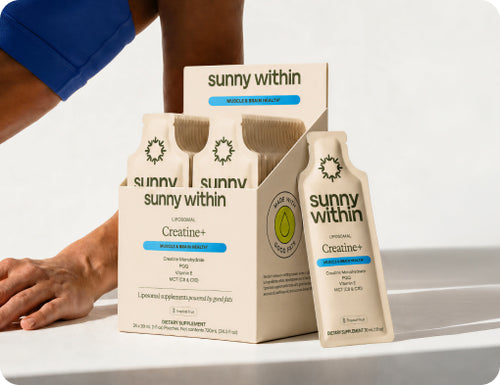
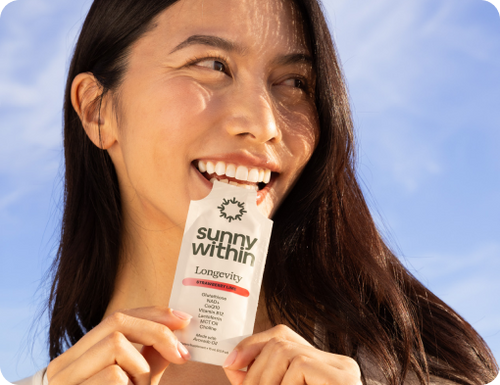
Sunny Within's Longevity formula, available in Strawberry Lime, combines NAD+, CoQ10, glutathione, B12, and MCT in a liposomal avocado oil base. At $109 per month, or $87 with a subscription, it is designed for people who want a comprehensive cellular energy formula in an absorption-optimized format. The Creatine+ formula at $69 per month ($55 with subscription) adds liposomal creatine monohydrate and PQQ alongside MCT for additional mitochondrial and performance support.
*These statements have not been evaluated by the Food and Drug Administration. This product is not intended to diagnose, treat, cure, or prevent any disease.
Sources:
- Bhagavan HN, Chopra RK. "Plasma coenzyme Q10 response to oral ingestion of coenzyme Q10 formulations." Mitochondrion. 2007.
- Harris CB, et al. "Dietary pyrroloquinoline quinone (PQQ) alters indicators of inflammation and mitochondrial-related metabolism in human subjects." Journal of Nutritional Biochemistry. 2013.
- Chowanadisai W, et al. "Pyrroloquinoline quinone stimulates mitochondrial biogenesis through cAMP response element-binding protein phosphorylation and increased PGC-1α expression." Journal of Biological Chemistry. 2010.